
Top 3 winners · 8 min read
Meet the Top 3 Winners of the Imagine Next Global Innovation Challenge
Sunchem, Airbuild, and Rapid Analytix Division are tackling three barriers to a more resilient future: recovering valuable metals, reconnecting water and nutrient cycles, and making lower-carbon construction materials easier to use with confidence.
A discarded circuit board still contains valuable metals. Nutrients that pollute a waterway could support growth in soil. A material capable of replacing part of the cement in concrete may remain underused because producers cannot assess its performance quickly enough.
The Top 3 Winners of the Imagine Next Global Innovation Challenge are building businesses around these overlooked opportunities.
Following the screening of more than 1,500 startups globally and in-depth evaluation of 162 companies, the Sustainable Innovation Council has selected Sunchem, Airbuild Inc., and Rapid Analytix Division Inc. as the challenge’s first-, second-, and third-place winners.
The three ventures work in different industries, but each addresses a practical obstacle to change. Sunchem is developing precision separation technologies that return metals from complex waste streams to productive use. Airbuild combines microalgae-based water treatment with biomass recovery. Rapid Analytix Division is developing fast material testing to support more reliable use of supplementary cementitious materials.
Together, they illustrate the challenge’s focus on planet-first innovation: technologies with a credible route to deployment and the potential to improve the systems around them.
First place: Sunchem
Recovering metals already within reach
Founder and CEO: Daniel T. Sun
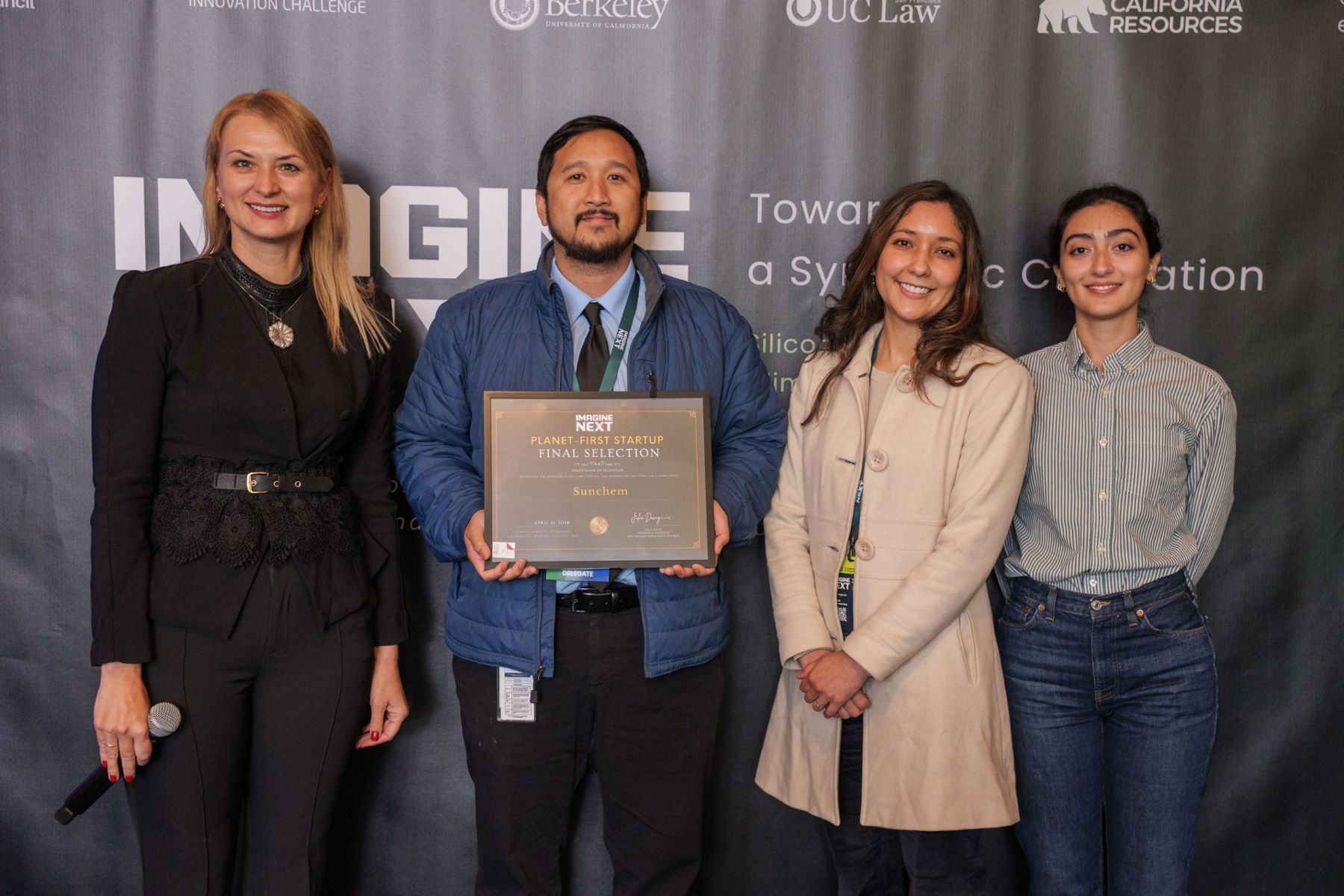
Electronics, renewable energy equipment, and advanced manufacturing depend on metals. Yet valuable metals also leave these industries in discarded products and manufacturing scrap. Recovering them requires separating small quantities of valuable material from complicated mixtures.
Sunchem is developing an integrated recovery process built around proprietary leaching formulations and selective Nano Filters. Its approach combines chemistry that brings target metals into solution with materials that capture and concentrate them, followed by regeneration and purification.
The technology’s research roots reach back to Lawrence Berkeley National Laboratory’s Molecular Foundry. As a research assistant in 2013, Daniel Sun worked on porous materials known as metal-organic frameworks and their ability to selectively capture heavy metals from water. After completing his doctorate, he founded Sunchem to bring this research into industrial use. Co-founder and CTO Dana Hernandez joined the effort as the company developed its technology and team.[1]
Selectivity matters because recovering a metal is only useful if the output meets the requirements of its next application. Berkeley Lab has reported that Sunchem produced 99.999% pure gold from a device manufacturer’s waste scrap, reaching a purity suitable for reintegration into device manufacturing. It also reported production of 99% pure gold and copper from waste printed circuit boards supplied by a Bay Area recycler.[1]
Sunchem’s submitted pitch materials describe an integrated sequence of leaching, separation, regeneration, and purification, with applications spanning electronic scrap, manufacturing waste, mining inputs, and solar-panel materials. These are distinct feedstocks, each requiring its own process development and validation.
The company has also begun moving beyond laboratory experiments. In an April 22, 2026 interview published by the Molecular Foundry, Sun described an 11,400-square-foot facility in West Berkeley, processing approximately 30–50 pounds of electronic waste or scrap per day. He identified larger processing lines as the next stage of development.[2]
For Imagine Next, the wider opportunity lies in what successful recovery could change. Returning high-purity metals to manufacturing could reduce losses along supply chains and make existing material stocks more useful. The environmental benefit will depend on the complete process, including chemical inputs, energy use, recovery yields, and management of residual waste.
Sunchem’s first-place recognition highlights both its precision separation technology and its progress toward applying that technology to real industrial feedstocks.
Explore Sunchem
Second place: Airbuild Inc.
Connecting cleaner water with nutrient recovery
Founder and CEO: David Gory Jr., M.S., MBA
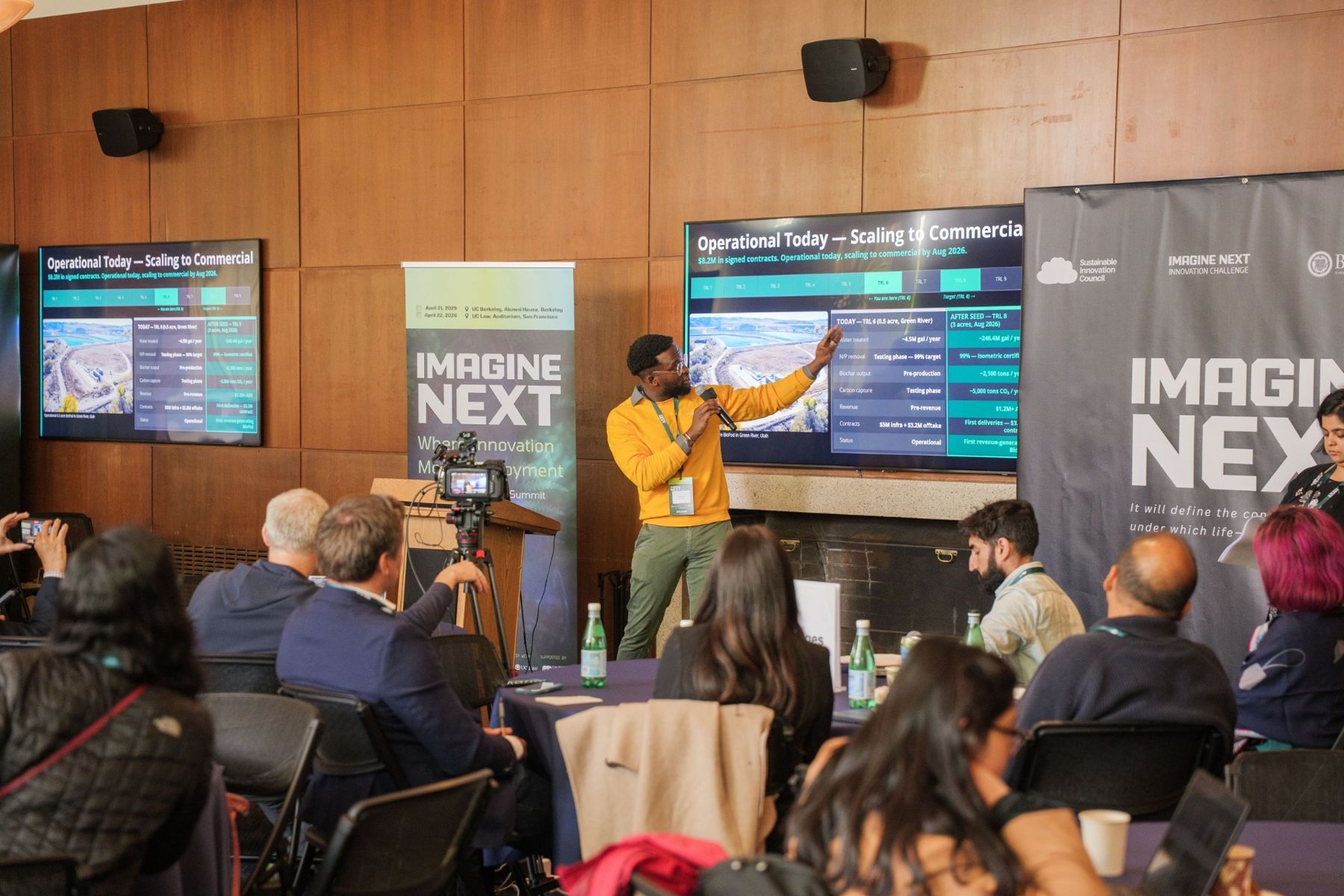
Nitrogen and phosphorus support life. When too much enters waterways, however, these nutrients become a pollution problem. Airbuild is developing a system that connects their removal from water with their recovery into useful biomass.
Airbuild’s modular, solar-powered pods use microalgae to combine water treatment, carbon uptake, and biomass production. Its submitted pitch materials describe systems designed for municipal lagoons and polluted waterways, with the aim of reducing dependence on utility connections and extensive new infrastructure.
The biological process creates the connection between these functions. Growing algae take up nutrients from water and incorporate carbon into biomass. Harvesting that biomass removes the accumulated material from the treatment system. Airbuild’s approach then combines harvested algae with local organic waste to produce biochar, creating a potential agricultural output from the recovery process.
This offers several possible sources of value: improved water quality, a useful destination for recovered nutrients and biomass, and carbon storage through biochar. Their combination could make treatment more attractive to communities that must otherwise bear its costs.
Airbuild has been developing a route to field deployment in Green River, Utah. In May 2025, the Economic Development Corporation of Utah announced plans for the company’s first microalgae facility on city-leased property. The project brought together the City of Green River, EDCUtah, USU Eastern, Better City, the Utah Inland Port Authority, and the University of Utah PEAK water sustainability engine.[3]
That collaboration is significant. Water technology must fit local conditions, permitting requirements, operating capacity, and community needs. A modular design offers the possibility of expanding treatment in stages, while a local deployment partnership creates a setting in which the technology can be tested against those conditions.
The climate and agricultural outcomes require equally careful measurement. Carbon absorbed during algae growth becomes durable removal only when subsequent processing and storage support that result. Agricultural use also depends on the quality and safety of the recovered material. Treatment performance, biomass handling, and biochar production therefore need to be assessed as one connected system.
Airbuild’s second-place recognition reflects the promise of bringing water remediation, resource recovery, and local economic activity together. Its potential systemic contribution is a closer relationship between what communities remove from water and what they can put to useful work elsewhere.
Explore Airbuild
Third place: Rapid Analytix Division Inc.
Giving lower-carbon concrete faster feedback
Founder and CEO: Bayezid Baten
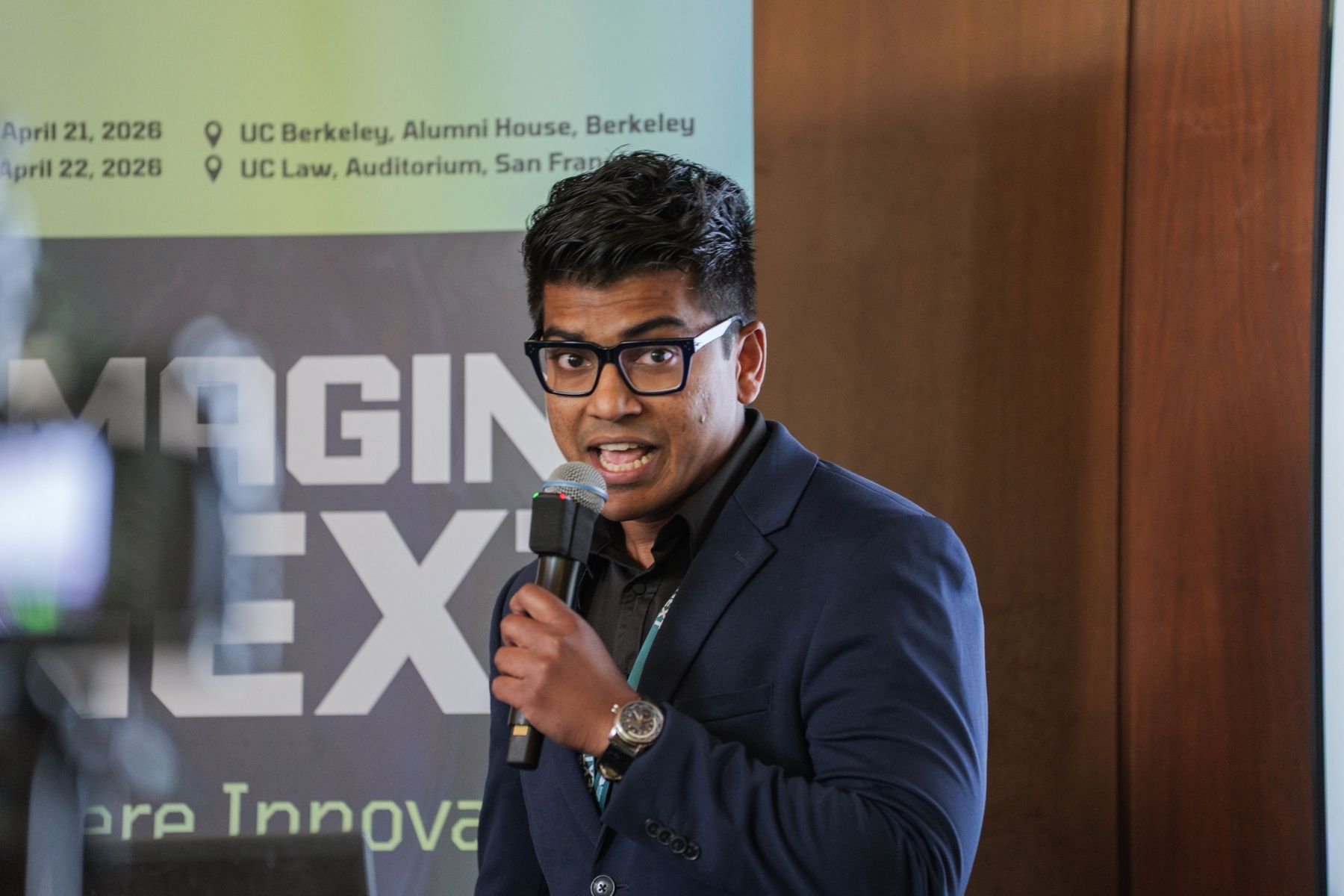
Concrete producers need confidence in the materials they use. Supplementary cementitious materials, or SCMs, can replace part of the Portland cement in a mix, but their composition and reactivity vary. Slow feedback makes it harder to respond to that variation during production.
Rapid Analytix Division, or RAD, is developing dissolution-based testing equipment that assesses material reactivity in approximately five minutes. Its submitted pitch deck describes automated testing and plans for both benchtop and inline versions, bringing material characterization closer to the pace of industrial decisions.
The company comes from the research environment of Professor Nishant Garg’s group at the University of Illinois Urbana-Champaign. The submitted team includes Bayezid Baten as CEO, Dr. Yujia Min as CTO, Farjad Iqbal as VP of Research, and Professor Garg as advisor.
Published research from the group provides evidence for the underlying approach. A 2025 paper in Cement and Concrete Research introduced the Ultra-Rapid Reactivity, or UR², test for calcined clays. Across 47 clay specimens, the researchers found that a five-minute dissolution-based measurement correlated strongly with seven-day reactivity results. They also reported a strong relationship with 28-day compressive strength across 14 clay mixtures.[4]
The distinction matters: a rapid reactivity measurement can help predict performance; it does not mean a concrete sample has undergone 28 days of curing in five minutes. The published study also establishes results for the materials tested, rather than guaranteeing the same accuracy for every SCM.
RAD’s commercial opportunity is to turn rapid measurement into practical quality control. Better information could help producers identify variation earlier, adjust formulations, and use suitable cement replacements with greater confidence. It could also reduce the incentive to add extra cement simply to compensate for uncertainty.
The company’s pitch materials report customer discovery, collaboration agreements, and purchase letters of intent. These indicate industry interest while the commercial equipment continues to develop.
RAD’s third-place recognition highlights an enabling technology whose impact could extend beyond the instrument itself. If producers can assess alternative materials reliably during production, more of those materials may become usable in everyday construction.
How the winners were selected
The winners were selected through the Imagine Next framework and SICouncil’s Symbiotic Investment Matrix.
The evaluation considered technological strength and deployment potential alongside environmental, community, and systemic priorities. That perspective asks what a venture could change beyond its immediate product: how it might affect resource flows, surrounding infrastructure, and the communities involved in its deployment.
The three winners offer different answers. Sunchem could strengthen the return of metals to manufacturing. Airbuild could connect water treatment with local resource recovery. RAD could help remove a quality-control barrier to lower-carbon construction.
Their recognition reflects the potential identified through the challenge’s evaluation. Each company’s ultimate impact will be established through deployment and measurable results.